Running the Adventure
Possession and Corruption
Dark fae Skin Dancers have come through the broken veil that separates the mundane world and the feywilds. They jump from host to host, ripping out of the bodies they inhabit and leaving behind a rotting corpse when they leave.
Possession
Skin Dancers can jump to a new host if their target is nearby and more than half of their target’s body is covered by the purple stain caused by the ooze.
Skin Dancers act erratically with sharp movements. They will sometimes try to use their host's mouth to ask questions in an ancient faen language. When their questions aren’t answered to their liking, they charge potential new hosts, attacking, grabbing, or ramming until enough corruption spreads so they can possess their target.
Corruption
The purple stain of corruption spreads on skin or fur over time, causing the corrupted individual to occasionally lose control and attack nearby creatures in fits of blind rage. The more corrupted a creature is, the more likely they are to have a fit of blind rage.
Adapt the spread of corruption and attacks of blind rage based on your system. Neither should cause the loss of HP or similar: The challenge should be about loss of control. Let the player decide how exactly the blind rage manifests. Don't force any PC fits of rage to last more than a few beats in the scene (or 2 rounds of combat/actions).
Spread of corruption and attacks of blind rage are triggered most often by states of high emotion or tension. You can also trigger them based on pacing and drama, increasing frequency as the adventure gets closer to the climax. Don’t trigger them randomly, but keeping the triggers somewhat unpredictable will keep fae magic strange and alien. Feel it out as you play.
The possessed and the corpses both release the purple ooze that causes the corruption. Corpses (besides Ivor’s) will stop releasing corruption after a sunrise. Corrupted but non-possessed living creatures don't release ooze.
Corruption happens after several seconds of contact with it, not immediately.
The Ticking Clock
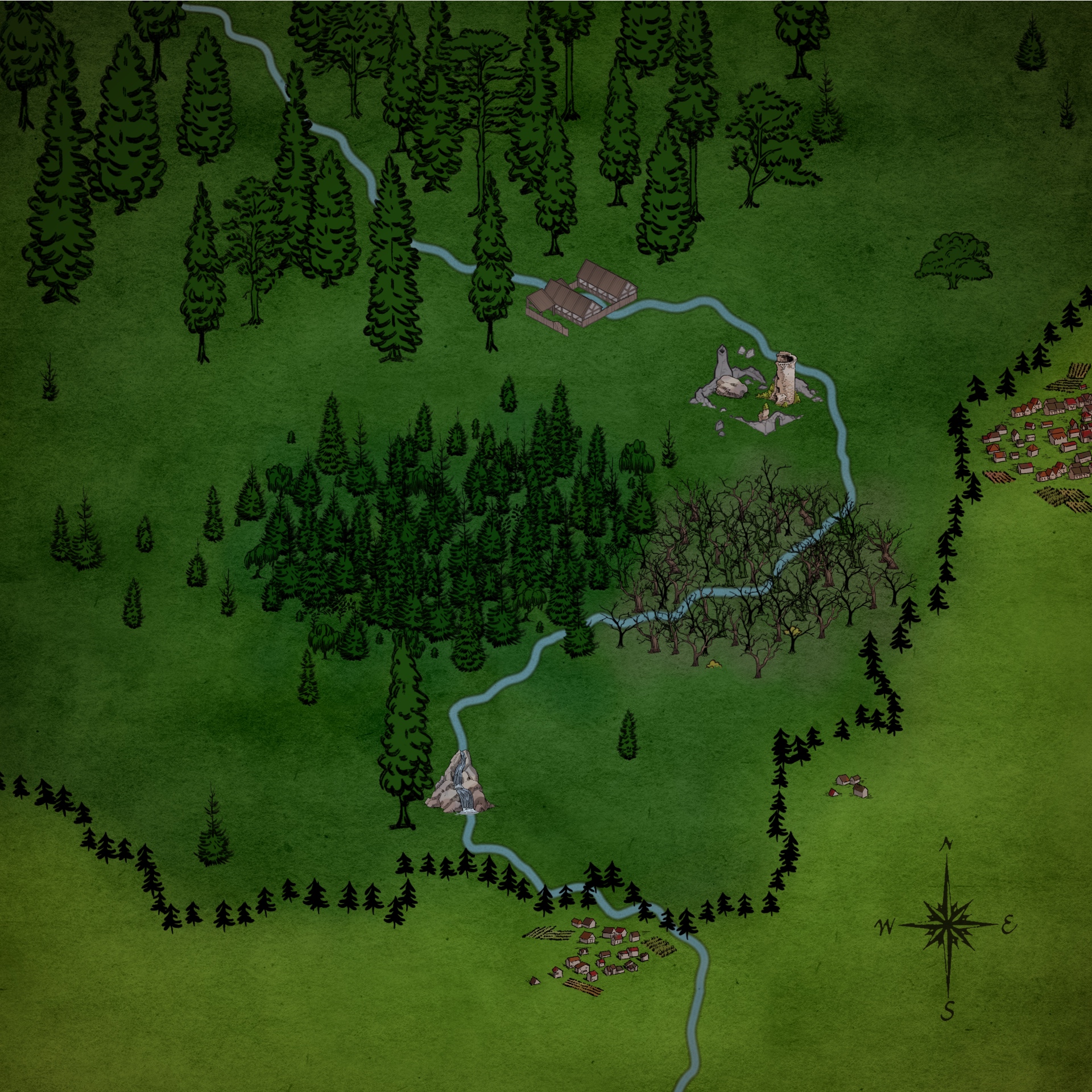
The wide flowing stream of ooze coming from Ivor's body flows south along and inside the East Einfelst river. It is the main ticking clock of the adventure. If the party does not act in time, Modaig's water reservoirs and wells will be lost to corruption and the town will become all but uninhabitable.
When the party reaches Easarin and encounters the main branch of flowing ooze for the first time, tell them freely that they estimate the corruption will reach Modaig in roughly 4 days. You can wait until they ask, but convey this before they leave the area.
There is advice in the Ending section on how to conclude the adventure, but the ticking clock is an open-ended problem for the party to solve. Importantly, to run this adventure in the spirit that is meant, the problems should be solvable.
Challenge the PCs and make the threat of the corruption reaching Modaig possible, but do your best to make it so that if the PCs fail, it was because of poor choices they made, not because doom was inevitable.
Timeline
| Time | Event |
|---|---|
| 14 Days Ago, Morning | Oathtree is cut down |
| 14 Days Ago, Afternoon | Skin Dancers break through and kill logger Ivor |
| 11 Days Ago | Morwenna finds Ivor, corruption spreads |
| 8 Days Ago | Morwenna order Steffan to scout |
| 4 Days Ago, Early Morning | Loiza leaves Modaig |
| 4 Days Ago, Afternoon | Loiza arrives at Easarin hot springs |
| 3 Days Ago, Morning | Loiza is killed by Steffan |
| 2 Days Ago, Evening | When Loiza was expected back in Modaig |
| Yesterday | The party is asked to find Loiza |
| Today, Afternoon | The party arrives at Easarin hot springs |
| In 4 Days | Corruption reaches Modaig |
Traveling in the Wilds
It takes roughly half a day to travel from one of the Forest Locations to another. Because of the rugged nature of the Einfelst Wilds, a traveler could only feasibly visit two of the locations in a single day (even on horseback).
Track the time of party movement against the ticking clock of the corruption reaching Modaig.
Presenting Information and Clues
Each location contains one or more Clues about the mystery or about where the party could go next:
Do not put this information behind a skill check or dice roll.
This adventure is structured to assume that a competent PC who actively investigates will always find the clues necessary to make progress.
The Witcher, Batman, Sherlock Holmes, and Benoit Blanc eventually find what they were looking for. It may cost them something like time, injuries, or innocent lives, but they always understand what happened by the end of their stories.
If the players are inquisitive or engaged while in the area of the clue, they automatically find it. Encourage the players to explain how their PCs learned the info if it's not already obvious in the fiction.
If you really want to use information discovery as an obstacle to challenge the PCs, you can put extra non-vital clues behind a skill check or dice roll.
Presenting Obstacles and Challenges
This adventure is system neutral and you will need to adapt it to the system you have. Add mechanics where appropriate, but don't go overboard.
There is at least one obstacle for the party to encounter at each location, but you should add, remove, relocate, and adjust obstacles to suit the pacing and to adapt to the player’s decisions.
Obstacle Inspirations
- A mother and child are lost in the Einfelst Wilds. They are traveling from Blackbraes to Modaig and they entered the forest to avoid road bandits.
- The terrain becomes too treacherous to cross.
- A small pack of goblins are hunting unusually close to human settlements because they've been kicked out of their tribe. They blame the corruption, and believe it was caused by humans.
- A fae creature causes the party to get lost in the woods. It will let the PCs get back on track if they pay a heavy price.
- Death, darkness, or foreboding threatens to overwhelm one or more of the PCs. Ask them how.
- A PC realizes that important supplies are missing from their pack. Either they forgot to re-pack them or another creature took them.
- A fae mushroom is bumped by one of the PCs, and the spores inhaled cause them to become instantly hostile against the other members of the party.
Running Creatures
There are no “stat blocks” in this system neutral adventure. If your system uses stat blocks, feel empowered to re-skin an existing stat block or create a new one that is appropriate for your game's tone and the amount you want to challenge the PCs.
Instead, creatures have lore blocks that contain 3 kinds of information: Obvious, Obscured, and Secret.
PCs should always see what's Obvious, put in effort to learn what's Obscured, and pay a price for what's Secret.
What’s Obvious
is the description of the creature. They are the things that the PCs immediately see and understand upon encountering the creature. It's automatic and free.
What’s Obscured
isn't obvious or automatic. Players/PCs have to ask questions to learn them. They are things that can be soon discovered or deducted. The info may come freely, or they may have to pay a small cost (like time, resources, or information).
What’s Secret
is always costly or risky to get. PCs have to find the answer in the world through exploration, trial and error, or by finding out the hard way.